When Ebola Threatens, Hope Must Reach the Forgotten First
The Democratic Republic of the Congo (DR Congo) says confirmed Ebola cases in the country have reached 1,307 and include 377 deaths, Al Jazeera reported on June 30, 2026.
And the World Health Organization’s African Region reports: “The Democratic Republic of the Congo is responding to an outbreak of Ebola disease caused by Bundibugyo virus in the north-eastern Ituri Province — the country's 17th Ebola outbreak since the virus was first identified in 1976.”
Additionally, the WHO Director-General has determined that the outbreak, which was declared on 17 May 2026, constitutes a Public Health Emergency of International Concern (PHEIC), requiring international coordination and cooperation for the response.
“The outbreak is unfolding against a complex epidemiological, humanitarian and security backdrop characterized by insecurity, highly mobile populations including cross-border and trade flows such as mining, as well as the presence of large refugee communities,” states WHO.
Sadly, “no licensed vaccine or specific treatment exists for Bundibugyo virus disease.”
At Bread and Water for Africa®, our immediate concern is that Ebola in the Ituri Province of the DR Congo might reach the Bikoro Province, where we support a mobile health clinic operated by our in-country partner there, Technologies Appropriées pour le Congo, Association Sans but Lucrative (TAC Asbl), to serve those living in remote communities, particularly indigenous groups such as the Pygmies.
As TAC executive director Lucien Beele put it in his request for the support for the mobile clinic, “This grant will play a pivotal role in advancing the long-term mission of TAC, which is to ensure equitable access to quality healthcare for underserved and marginalized populations.”
“By reinforcing our operational capacity and deepening community engagement through the training of local health workers, the support will help institutionalize a sustainable, community-led healthcare model,” says Lucien.
“Ultimately, it will allow TAC Asbl to transition from a mobile clinic initiative to a long-term, scalable solution that addresses systemic health disparities and contributes to improved public health outcomes in the region.”
The regions to be served through the mobile clinics, he explained, “are home to some of the most vulnerable populations, particularly indigenous Pygmy communities, who face extreme barriers to accessing basic healthcare due to geographic isolation, poverty, and lack of infrastructure.”
He expects that a total of 7,500 people from 25 villages will be benefiting from the mobile clinic, with an estimated 50 to 75 individuals daily – particularly children under 5 years old, who are most vulnerable to preventable diseases, pregnant and breastfeeding women, who require regular maternal health services, the elderly and chronically ill who need consistent medical follow up and the indigenous Pygmy populations which face systemic barriers to accessing healthcare.
In sum, says Lucien, “the major impact expected from this grant is, first and foremost, a marked improvement in access to healthcare for disadvantaged groups living in the rural areas of the Ntondo, Iboko, and Bikoro health zones.
“By organizing mobile clinics, we can reach the most isolated villages, providing medical consultations, prenatal and postnatal vaccinations, and other care.
“In this way, we hope to contribute to a significant reduction in morbidity and mortality from certain preventable diseases, particularly among the Pygmy communities, who are undoubtedly the most vulnerable and often less well off than other population groups.”
Among the services provided in the past year included general medical consultations for common and acute conditions, malaria screening and treatment (particularly for children under 5 and pregnant women), treatment of waterborne diseases such as cholera and Typhoid fever, management of respiratory infections and skin diseases, nutritional screening MUAC (Mid-Upper Arm Circumference – widely used by UNICEF to screen children under 5), health education sessions focusing on hygiene, safe water use, nutrition and malaria prevention, as well as distribution of essential medicines and referral of severe or complicated cases to nearby health facilities where possible.
Residents of Nkake Village, which has no health facility, such as Mr. Iyela Maadu, told us that “the mobile clinic has changed daily realities, allowing children to receive early treatment for malaria and diarrheal diseases and preventing deaths caused by delays in care.
“For Nkake, the support provided through Bread and Water for Africa® directly translates into access to life-saving services where none previously existed.”
In addition, Lucien described the visit to the region by Bread and Water for Africa® executive director Beth Tessema. In January, to view mobile clinic activities in Nkaka as “a landmark moment” which strengthened the partnership between Bread and Water for Africa® and TAC, as well as “reinforced community confidence and morale” regarding the mobile clinic operations.
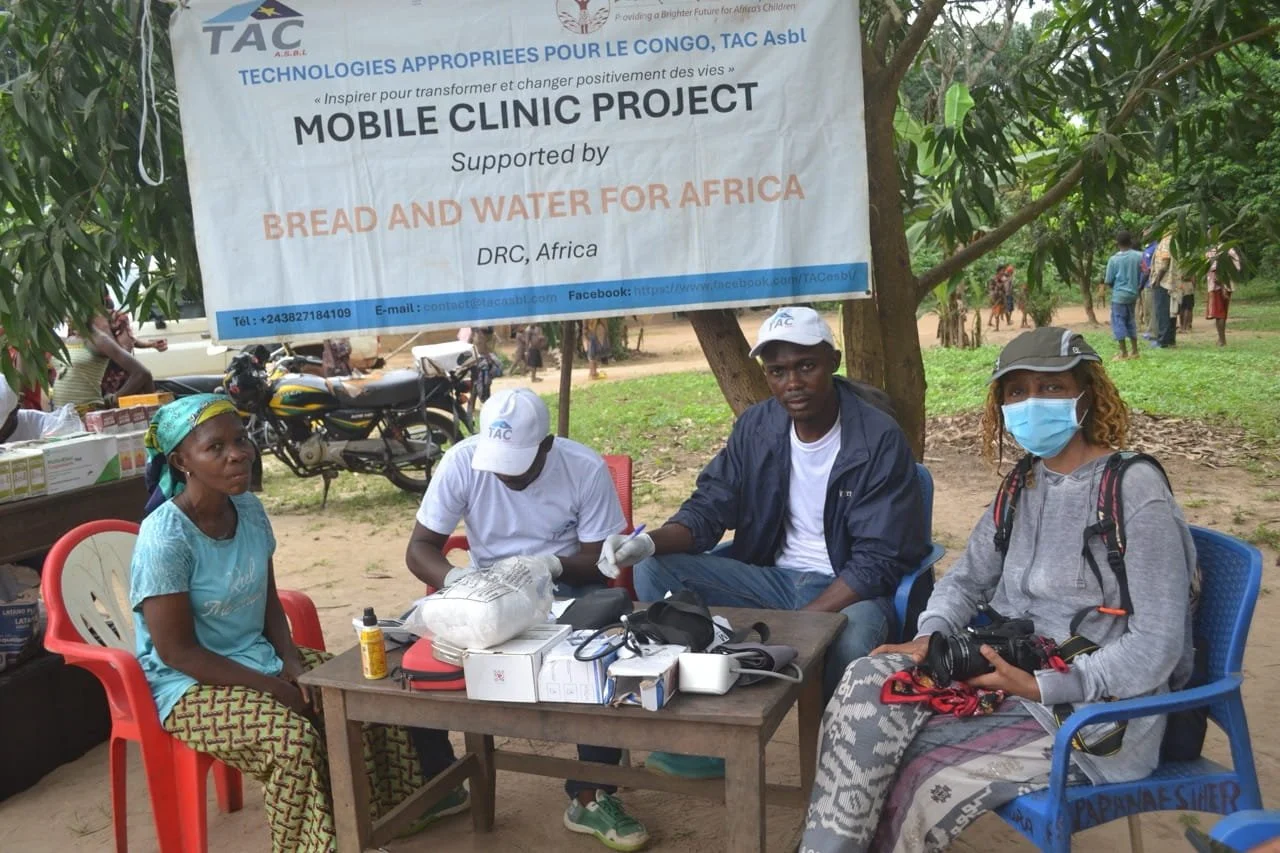
“Her presence allowed her to experience the real lives that remote communities face, the operational challenges of providing healthcare in far-off areas, and primarily the tangible and essential effect of mobile healthcare interventions enabled by donor funding.
“Community members openly expressed gratitude, emphasizing that mobile clinics often represent their only access to professional healthcare,” reported Lucien.
As for Beth, reporting to the Bread and Water for Africa® board of directors, she stated: “The mobile clinic operation is truly remarkable, overcoming numerous challenges posed by the surrounding environment.
“The road conditions are particularly difficult, with potholes, broken bridges, and complicated transportation hubs making travel a constant challenge.
“The urban and semi-urban areas, with their bustling traffic and infrastructure demands, only add further logistical hurdles.
“In addition, poorly maintained roads make access to essential medical care even more difficult, and during the rainy season, many roads become impassable.
“The successful execution of the operation despite these obstacles is both inspiring and a testament to resilience and determination.”
She also had nothing but praise for those dedicated healthcare workers on the frontlines, saying, “One of the most striking aspects of the operation is the unwavering commitment of healthcare workers.
“Despite the challenges, these dedicated professionals travel to remote locations four to five days weekly to serve vulnerable and underserved communities.
“Their courage and commitment to providing essential medical care to those in need are truly inspiring.
“They navigate difficult terrain, often facing adversity in their pursuit of improving the well-being of those they serve.”
Beth, who has traveled to many of the sub-Saharan African countries where Bread and Water for Africa® operates, commented that “my trip to the DR Congo stands out as particularly inspiring.
“Despite the challenges posed by conflict, the resilience and spirit of the people in the DRC shine through.
“The visit highlighted the tangible impact of our work in a nation rich in natural resources but also burdened by decades of conflict and despair.
“Although there are no straightforward solutions to the challenges the country faces, we remain dedicated to serving the most neglected and underserved communities in the DR Congo.”